
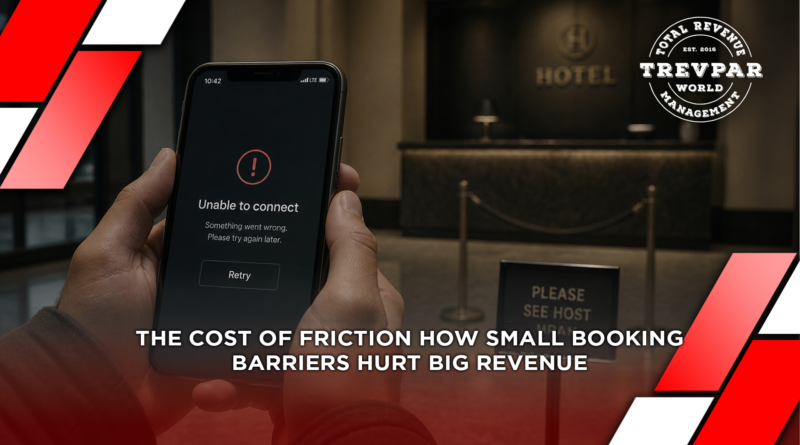
The Cost of Friction: How Small Booking Barriers Hurt Big Revenue
In this modern, hyper-targeted world of hospitality leadership, every percentage point towards RevPAR matters. Yet many hotel groups and independent properties unknowingly leak significant revenue through seemingly minor issues in the booking journey. At TrevPAR World Group, our revenue management, data analytics and marketing communication teams run audits, that repeatedly uncover ”friction” , which are small, often invisible barriers that prevent interested guests from completing reservations. The cumulative cost of this ”friction” is substantial losses in direct bookings, higher OTA dependency, and suppressed profitability.
”Friction” refers to any element that creates hesitation, confusion, or effort during the booking process. Guests today expect speed, simplicity, and clarity. When they encounter resistance, they abandon the process at alarming rates, often within seconds.
Common Booking Barriers We Identify
Our work with properties all over South Africa, from the Western Cap to the Garden Route, from Gauteng, down to KwaZulu-Natal has revealed various recurring friction points:
- Slow website load times (especially on mobile,)
- Complicated multi-step booking forms requiring excessive information upfront
- Unclear or hidden fees, taxes, and cancellation policies
- Poor rate presentation and lack of transparent comparisons
- Non-intuitive navigation or broken mobile experiences
- Absence of immediate reassurance (live chat, trust badges, real-time availability)
Each of these small hurdles might seem insignificant on its own. However, industry data shows that even a one-second delay in page load can reduce conversions by 7%. In hospitality, where average website conversion rates already hover between 2–3%, these frictions compound rapidly. Our team of experts have analysed a number of properties and found that some properties are losing as much as 40% of potential direct bookings due to cumulative friction, forcing greater reliance on high-commission OTAs and eroding net RevPAR.
The Real Financial Impact
If you consider the math. A mid-sized hotel generating 50,000 website sessions per month with a 3% conversion rate yields 1,500 bookings. Introduce moderate friction that drops conversions to 2%, and you lose 500 bookings monthly. At an average rate of R2,500 per booking, that’s R1.25 million in lost revenue per month, much of which shifts to OTA’s at 15–25% commission. Annually, the impact on profitability can reach tens of millions for larger portfolios.
Beyond immediate revenue, friction damages long-term value. Guests who encounter barriers are less likely to return or recommend your property, weakening brand equity and guest lifetime value.
Reducing Friction: A High-ROI Executive Priority
Leading hospitality executives treat the booking journey as a core revenue management asset. The solution lies in systematic diagnosis and relentless optimisation. At TrevPAR World Group, we help leadership teams:
- Conduct detailed funnel analytics to pinpoint exact drop-off locations
- Redesign booking engines for speed, simplicity, and mobile excellence
- Implement transparent pricing and dynamic presentation strategies
- Integrate trust signals and personalization to reduce hesitation
- Align marketing, revenue, and digital teams around frictionless experiences
Take Control of Your Revenue Pipeline
Properties that eliminate friction don’t just capture more bookings, they deliver superior guest experiences from the very first interaction, building loyalty and protecting margins. At TrevPAR World Group, we partner with forward-thinking leaders to identify, quantify, and eliminate costly friction. Our data-driven approach ensures your booking journey becomes a competitive advantage rather than a hidden liability. If you are ready to calculate and recover the revenue you’re currently losing? Contact TrevPAR World Group for a comprehensive Booking Journey Friction Audit. In hospitality, removing barriers isn’t just about better conversions, it’s about building sustainable profitability.
For more industry related news, click here.


